Degree Fahrenheit, unit of measure |
| Fahrenheit is a temperature scale named after the Polish-German physicist Daniel Gabriel Fahrenheit (1686-1736), who proposed it in 1724. In this scale, the freezing point of water is 32 degrees Fahrenheit (written "32 °F"), and the boiling point is 212 degrees, placing the boiling and freezing points of water exactly 180 degrees apart. Negative 40 degrees Fahrenheit (-40 °F) is equal to negative 40 degrees Celsius (-40 °C). Absolute zero is at -459.67°F. The Fahrenheit scale was the primary temperature standard for climatic, industrial and medical purposes in most English-speaking countries until the 1960s. In the late 1960s and 1970s the Celsius (formerly centigrade) scale was phased-in by governments. In the United States the Fahrenheit system continues to be the accepted standard for non-scientific use. |
To perform conversions between degree Fahrenheit and other Temperature
units please try our
Temperature Unit Converter
Convert degree Fahrenheit to:
kelvin, degree Celsius, degree Rankine, degree Reaumur, Triple point of water
|
 |
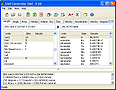 Download Temperature Unit Converter
our powerful software utility that helps you make easy conversion between more than 2,100 various units of measure in more than 70 categories.
Discover a universal assistant for all of your unit conversion needs -
download the free demo version right away!
|
 |
|
|
|
|
|